The 2026 Ultimate Guide to Non-Surgical Brow Lifts for Hooded Eyes
What Exactly Are Hooded Eyes vs. Droopy Eyelids, and How Does a Non-Surgical Brow Lift Specifically Help Hooded Eyes?
Many individuals notice that their eyelids make their eyes appear smaller. This article discusses the 2026 Guide to Non-Surgical Brow Lifts for Hooded Eyes.
Hooded eyes occur when excess skin from the brow folds over the crease, reducing the visibility of the eyelids. Droopy eyelids, or ptosis, differ in that the eyelid edge sits lower than usual.
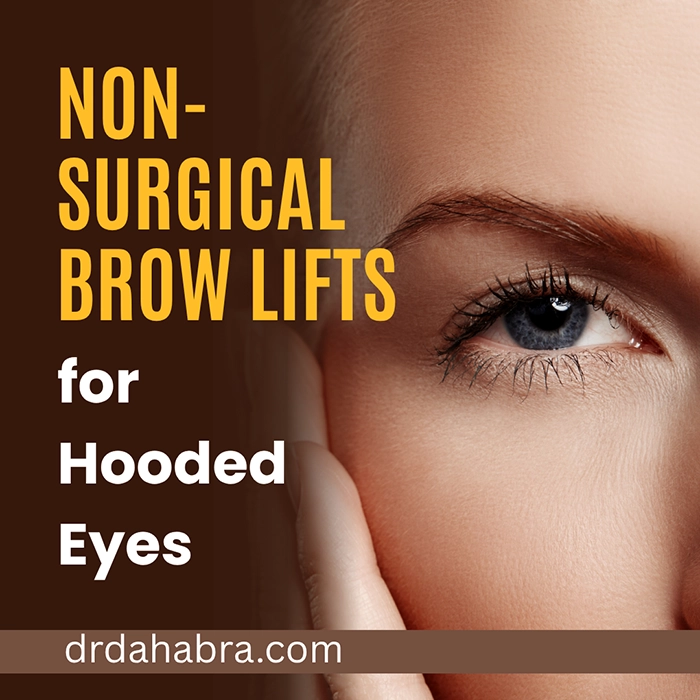
A non-surgical brow lift raises the brow by targeting muscles and skin above the eye. Instead of removing skin, techniques are used to help the brow sit higher, making the eyes look more open and refreshed without surgery.
This gives the eye area more support. By shifting the brow, more of the eyelid becomes visible.
These small changes help the eyes look brighter and younger.
Table of Contents
1. Is it Possible to Lift Hooded Eyes With Just Botox®?
2. How Do PDO Thread Lifts Provide an Instant Mechanical Lift for Sagging Brows?
3. Can Dermal Fillers Create Structural Support Under the Brow to Reduce Hooding?
4. How Do Energy-Based Devices Like Ultherapy Tighten Skin Around the Eyes?
5. Does Laser Coring Offer Bleph-Like Results for Upper Lid Skin?
6. What Are the Primary Benefits of Choosing a Non-Surgical Eye Lift?
7. What Risks and Considerations Should You Know Before Your Treatment?
8. Is the Botox® Brow Lift Truly the Most Effective Non-Invasive Option?
9. What is the “Spock Brow” and How Can You Avoid This Common Complication?
10. Can Dermal Fillers Be Used Together With Neurotoxins for Better Results?
11. What If One Side Of My Lip Looks Higher Than The Other?
12. Does Ultherapy Truly Tighten the Brow Area Over the Long-Term?
13. How Does Radiofrequency (RF) Microneedling Improve Chronic Eyelid Hooding?
14. What is the New “Plasma Pen” Treatment for Lifting Hooded Lids?
15. Frequently Asked Questions (FAQs)
16. Conclusion
17. References
1. Is it Possible to Lift Hooded Eyes With Just Botox®?
You might view Botox® as a wrinkle smoother, but it expertly balances muscle control.
Facial muscles compete: some lift, others pull down. The orbicularis oculi muscle (the ring of muscle around your eye responsible for closing your eyelids) squeezes the eye shut and pulls the tail of the brow down.
Strategic Botox® injections relax this muscle. Botox® is a medication that temporarily weakens muscles by blocking nerve signals, preventing the muscle from contracting.
Relaxing the muscle that lowers the brow allows the forehead muscles (which help raise the eyebrows) to elevate the area, resulting in a subtle, aesthetically pleasing arch. This approach is commonly called a chemical brow lift, as it relies on altering neuromuscular signals (signals that control muscle movement) rather than mechanical methods.
This method helps with mild to moderate eyelid hooding. Patients with significant skin excess may need other options.
For many, the procedure gives fast, low-disruption brow enhancement and brief downtime. minimally disruptive brow enhancement with minimal downtime.
2. How Do PDO Thread Lifts Provide an Instant Mechanical Lift for Sagging Brows?
If Botox is a gentle option, PDO threads are a stronger way to lift.
PDO threads are tiny, dissolvable stitches (made from polydioxanone, a safe material used in sutures) that a provider places under your skin to raise the brow. The threads hold the skin firmly, allowing the provider to lift the area instantly.
Another advantage of PDO threads is continued tissue enhancement. While the threads remain in place, the body forms new collagen around them.
Even after dissolution, the collagen persists. PDO threads are suitable for individuals not considering surgery or requiring more than a chemical brow lift.
Results are visible immediately, and recovery is typically short, with mild tightness or tenderness for several days.
3. Can Dermal Fillers Create Structural Support Under the Brow to Reduce Hooding?
Sometimes hooded eyes result from a loss of support beneath the skin, not just sagging.
As we age, we lose fat and bone around the eyes, causing the skin to collapse. Dermal fillers are injectable gels commonly made from hyaluronic acid—a substance found naturally in the body that attracts and holds moisture.
These fillers act like small invisible cushions. Injecting hyaluronic acid boosts volume under the skin.
This support is crucial for temple volume loss. When temples hollow, the brow tail loses support and slides downward.
Filling the gap provides a sturdy base and lifts the eyebrow tail. It’s a refined fix for a droopy brow. It’s a very sophisticated way to handle a droopy brow.
Filler provides support beneath the skin, keeping it firm so the eye area looks smoother and more lively. This subtle change refreshes your appearance.
4. How Do Energy-Based Devices Like Ultherapy Tighten Skin Around the Eyes?
Ultherapy uses focused ultrasound energy to heat deep layers of your skin, targeting the same areas as a facelift.
Ultrasound energy is sound waves at high frequency that can penetrate the skin. Instead of needles or threads, it uses heat.
The device creates small points of heat that trigger your body’s repair process.
Results develop gradually. Over several months, the body increases collagen and elastin production, resulting in tighter, firmer eyelid skin.
This gradual improvement produces a rejuvenated appearance.
Radiofrequency skin tightening works similarly but usually targets more superficial layers. Radiofrequency (RF) uses controlled electrical energy to heat skin tissue, stimulating collagen, which is a protein that keeps skin firm and elastic.
Both are excellent for people who want to avoid injectables or surgery entirely. It’s a great way to address heavy eyelids by strengthening the skin and making it more resilient.
It’s literally teaching your skin how to act young again.
5. Does Laser Coring Offer Bleph-Like Results for Upper Lid Skin?
Laser coring is a newer treatment that stands out.
Traditional lasers treat the skin’s surface, but devices like UltraClear remove very small, precise areas of skin. By removing a small portion, this process produces significant tightening, with results comparable to those achieved through surgical or non-surgical blepharoplasty.
Physically removing a small amount of excess skin is considerably more effective than topical creams or mild peels. This technique is particularly beneficial for loose, finely wrinkled skin located directly on the upper eyelid. effective for that crinkly, crepey skin that sits right on the lid.
The downtime is manageable. You might look a bit red or have small marks for a few days, but the result is skin that appears noticeably smoother and more lifted.
This treatment is suitable for skin laxity rather than a heavy brow muscle. It focuses on improving the skin around your eyes.
6. What Are the Primary Benefits of Choosing a Non-Surgical Eye Lift?
The biggest win with a non-surgical eye lift is the lack of a “scary” recovery.
Most people can get these treatments done on a Friday and be back at work on Monday—sometimes even the same afternoon! There are no general anesthesia risks, no large incisions, and no permanent scars to worry about.
It’s a much more approachable way to rejuvenate the eyes.
Then there’s the “natural” factor. Surgery can sometimes leave people looking “surprised” or “wind-swept” if it’s done too aggressively.
Non-surgical methods are much more incremental. You can start with a little Botox® and add a bit of filler or a thread lift later.
It allows you to age gracefully and keep everyone guessing why you look so refreshed.
Lastly, the price point is often much friendlier for your wallet. While surgery is a major one-time investment, non-surgical options let you spread your brow lift costs over time.
You can choose the treatments that fit your budget and your goals, making high-end beauty more accessible to everyone.
7. What Risks and Considerations Should You Know Before Your Treatment?
While we love these treatments, they aren’t without their quirks.
With a Botox® brow lift, if the injector isn’t careful and places the product too low on the forehead, it can actually have the opposite effect. It can paralyze the muscles that raise the brow, leading to a “heavy” feeling or even a temporary droop.
This is why you always want a pro who knows their anatomy.
Thread lifts come with their own set of rules. You might see a little bruising or feel a “tugging” sensation for a week or two.
In very rare cases, a thread might become visible or move, though a skilled hand makes this very unlikely. It’s important to remember that these are temporary solutions; your body will eventually break down the threads and the Botox®.
You also need to have realistic expectations. If your hooding is very severe, a non-invasive eye lift might only give you a modest improvement.
It’s a conversation about what’s possible. Sometimes, a liquid brow lift is perfect, but other times, it’s just a “bridge” until you’re ready for the real deal.
8. Is the Botox® Brow Lift Truly the Most Effective Non-Invasive Option?
The answer is: it depends on what’s causing the hooding!
If your brows are heavy because you’re constantly frowning or squinting, then yes, an eyebrow lift botox® is likely your best friend. It tackles the root cause by calming those overactive muscles.
It’s the gold standard for a reason—it’s predictable, relatively cheap, and has basically zero downtime.
However, if your hooded eyes are caused by a “hollow” look or very loose skin, Botox® alone might feel like it’s missing the mark. It can’t add volume, and it can’t cut away skin.
It simply changes the posture of your brow. For many people, the “most effective” treatment is actually a combination of several factors.
Think of Botox® as the foundation. It sets the stage by relaxing the downward pressure.
Once that’s done, you can see if you need a little “scaffolding” with filler or some “shrink-wrapping” with a laser. It’s almost always the first step in a non-surgical eye-lift journey because it’s so effective.
9. What is the “Spock Brow” and How Can You Avoid This Common Complication?
We’ve all seen it—that look where the tail of the eyebrow shoots up at a sharp, unnatural angle, making someone look like they’re from Star Trek.
This happens when the middle part of the forehead is frozen with Botox®, while the outer edges still move. The outer muscles overcompensate, pulling the tail of the brow way too high.
The good news?
It’s incredibly easy to fix. A tiny touch-up of Botox® just above that high point will settle the muscle down and bring the brow back to a natural, soft arch.
A great injector will usually start conservatively and have you come back in two weeks to see if a little tweak is needed to keep things looking “human.”
To avoid it from the start, talk to your provider about wanting a “soft” lift rather than an aggressive one. They should map out your unique muscle movements before they ever pick up a needle.
It’s all about balance—lifting the eye without making you look like you’re perpetually surprised by a ghost.
10. Can Dermal Fillers Be Used Together With Neurotoxins for Better Results?
Absolutely! In fact, this is the “secret sauce” for many celebrities.
Combining Botox® with dermal fillers is often called a liquid brow lift. While the Botox® relaxes the muscles that pull the brow down, the filler adds the volume needed to support the skin and give the brow bone a more youthful, defined shape.
Using them together addresses two different aging problems at once: muscle tension and volume loss. It’s like renovating a house—the Botox® fixes the foundation, and the filler does the structural work.
This duo can create a much more dramatic lift than either treatment could achieve on its own, especially for hooded eye solutions.
This combo is particularly great because it can be customized to your exact face shape. Maybe you need more lift at the tail, or maybe you need more support in the middle.
By mixing and matching these tools, your provider can sculpt a look that is uniquely yours, making your eyes look wide, bright, and beautifully framed.
11. What If One Side Of My Lip Looks Higher Than The Other?
Facial asymmetry is incredibly common.
Almost nobody has a perfectly symmetrical face. Sometimes, after a Botox® lip flip, you might notice that one side of your lip is pulling slightly higher than the other side.
Do not panic if this happens. It usually just means one side of your orbicularis oris muscle is stronger than the other.
Your body is metabolizing the neurotoxin at slightly different rates.
Why did my lip flip only last 4 weeks?
You might have a hyperactive metabolism, or you naturally use your mouth muscles very aggressively. A quick touch-up with your injector can easily fix any imbalance.
How often should you schedule maintenance?
Every two to three months is perfect. They will simply add one or two tiny lip-flip units to the stronger side to even things out.
This is exactly why lip flip maintenance appointments matter so much for perfect results.
12. Does Ultherapy Truly Tighten the Brow Area Over the Long-Term?
Ultherapy is the marathon runner of non-surgical treatments.
While a Botox® brow lift wears off in a few months, the results from an ultrasound brow lift can last a year or even longer. This is because it’s not just a temporary chemical change; it’s a physical restructuring of your skin’s collagen.
You are essentially building a stronger, tighter “mesh” under your skin.
Because the collagen production happens slowly, the lift looks completely natural. There’s no sudden change that makes people ask what you did.
Instead, you just look better and better as the weeks go by. It’s a fantastic option for someone who wants to “bank” collagen for the future and slow down the aging process in the eye area.
Is it a replacement for surgery?
For deep, heavy hoods, maybe not. But for maintaining your brow position and keeping the skin above the eyes from becoming too lax, it’s one of the best tools we have.
It’s an investment in your skin’s future health and elasticity.
13. How Does Radiofrequency (RF) Microneedling Improve Chronic Eyelid Hooding?
RF microneedling is like a double-whammy for hooded eyes.
The tiny needles create controlled micro-injuries that trigger healing, while the radiofrequency energy heats the deeper layers to tighten the skin. This dual action is incredibly effective at smoothing out the “crepe-paper” texture that often makes hooded eyes look even heavier.
When we use this around the brow and upper lid area, it causes the skin to contract and thicken. This improved skin quality means the lid is less likely to sag and fold over the eye.
It’s a brilliant way to tighten eyelid skin without a scalpel. It basically “shrink-wraps” the loose skin.
You usually need a series of treatments to see the best results, but the payoff is worth it. Not only do your eyes look more lifted, but the skin itself looks healthier, brighter, and more resilient.
It’s a great way to refresh your look if you’re starting to see those first signs of “heavy” lids.
14. What is the New “Plasma Pen” Treatment for Lifting Hooded Lids?
The plasma eye lift—sometimes called “fibroblasting”—is a fascinating technology.
It uses a tiny arc of plasma (ionized gas) to singe the very surface of the skin in a grid of tiny dots. As these tiny spots heal, they pull the skin together, tightening dramatically.
It’s a non-invasive way to physically “shrink” the excess skin on the upper lid.
It’s particularly popular for people who have specific “folds” of skin they want to get rid of. Because the provider can target exactly where they place the dots, it’s a very precise treatment.
It can help create a more defined crease and lift the hooded skin away from the lash line.
The healing process involves some tiny crusts or “dots” that stay on the skin for about a week, so you do need a little bit of downtime. But once those dots fall off, the skin underneath is tighter and more refreshed.
It’s a powerful tool for those looking for a significant non-surgical change to their hooded eyes.
15. Frequently Asked Questions (FAQs) About The 2026 Guide to Non-Surgical Brow Lifts for Hooded Eyes
Q1. What is the best non-surgical eye lift for hooded eyes?
Concise Answer: A combination of Botox® for lift and Ultherapy for skin tightening is often considered the gold standard.
Detailed Answer: While there isn’t a single “perfect” treatment, most experts recommend a multi-layered approach to get the best results. Botox® relaxes the muscles that pull the brows down, while energy-based treatments like Ultherapy or RF microneedling actually tighten the skin.
If you have significant volume loss, adding temple filler can also make a huge difference in how open your eyes look.
Q2. Does a brow lift fix hooded eyes?
Concise Answer: Yes, by elevating the eyebrow position, it pulls the excess skin upward and away from the eyelid.
Detailed Answer: The whole point of a brow lift is to address the “heaviness” coming from above. When the brow sits higher, the skin that was previously folding over your eyelid is pulled tauter, which reveals more of your actual eyelid.
It doesn’t remove the skin like surgery does, but it repositions it so it’s no longer “hooding” your gaze.
Q3. How long does a non-surgical brow lift last?
Concise Answer: Results vary from 3-4 months for Botox® to over a year for Ultherapy and PDO threads.
Detailed Answer: It really depends on what tool you choose! Neurotoxins like Botox® or Dysport wear off as your body regrows nerve receptors, which usually takes about three to four months.
PDO threads and energy-based treatments last much longer because they stimulate your body to produce its own collagen, which lasts 12 to 18 months.
Q4. How do I hide hooded eyes with makeup?
Concise Answer: Use a matte transition shade above your natural crease to create the illusion of depth.
Detailed Answer: Makeup for hooded eyes is all about “faking” a crease you can actually see. Since your natural crease is hidden, apply your darker eyeshadow slightly higher on the brow bone while your eyes are open.
This makes your eyes look much larger and more deep-set, and using a thin eyeliner ensures you don’t “black out” what little lid space you have.
Q5. How do I fix the muscle and skin structure without a scalpel?
Concise Answer: Use a combination of neurotoxins for muscle balance and collagen-boosting lasers for skin structural integrity.
Detailed Answer: Fixing the structure is a two-part job: you have to train the muscles to stay up and the skin to stay tight. Botox® handles the muscle posture, while treatments like Ultherapy or Fraxel work on the “scaffolding” of the skin.
Together, they improve the internal architecture of your eye area without ever needing an incision.
Q6. What is the Real Downtime After a Brow Thread Lift?
Concise Answer: You can expect about 2-5 days of minor swelling, bruising, or a “tight” sensation.
Detailed Answer: Most people are totally fine to go out in public the next day with a little concealer, but you might feel a bit of a “pulling” sensation when you make big facial expressions. It’s best to avoid heavy exercise for a few days so the threads can settle into place.
Compared to the weeks of bruising from surgery, it’s incredibly manageable.
Q7. Is Laser Skin Resurfacing Better Than Injectables for Skin Laxity?
Concise Answer: Yes, lasers are superior for tightening loose skin, while injectables are better for muscle movement and volume.
Detailed Answer: Think of it this way: if your skin is “crepey” or thin, a laser is going to do much more for you than Botox® ever could. Lasers actually change the quality and thickness of the skin itself.
However, if your hooding is caused by a low-hanging brow bone, injectables are the way to go.
Q8. Why did my eyebrows get heavier after forehead Botox®?
Concise Answer: This usually happens when too much Botox® is placed in the forehead muscle, which is the only muscle that lifts the brows.
Detailed Answer: The frontalis muscle is your “lifter.” If you freeze it too much to get rid of forehead lines, the brow loses its support and slides down.
A skilled injector will always balance forehead Botox® with a “lift” at the tail of the brow to prevent this heavy, “caveman” look.
Q9. Does temple filler actually make your eyes look less hooded?
Concise Answer: Yes, it acts as an anchor, pulling the skin at the outer corner of the eye back and up.
Detailed Answer: When your temples hollow out, the skin has nothing to sit on, so it sags forward over your eyes. By restoring that volume, you’re basically “taking up the slack” in the skin.
It’s one of the most effective ways to lift the tail of the brow and open up the lateral part of the hooded eye.
Q10. Can I use an at-home microcurrent device (Nuface) to lift my brows?
Concise Answer: At-home devices provide a very temporary, subtle lift by stimulating muscle tone, but they require daily use.
Detailed Answer: Microcurrent is like a “workout” for your face. It can give you a nice little boost for a few hours or a day, but it’s not a permanent fix.
It’s a great maintenance tool to use between professional treatments, but it won’t give you the same dramatic results as Botox® or threads.
Q11. Botox® vs Dysport: Which one gives a better lift for hooded eyes?
Concise Answer: Both are excellent, but Dysport tends to “spread” a bit more, which some injectors prefer for a softer brow lift.
Detailed Answer: It really comes down to your practitioner’s preference and how your body reacts. Some people find that Dysport kicks in faster (2-3 days) compared to Botox® (5-7 days).
In the hands of a pro, both can achieve a beautiful, arched result that opens up hooded lids perfectly.
Q12. What happens when PDO threads dissolve? Does the skin sag more?
Concise Answer: No, the skin actually stays firmer because the threads leave behind a “path” of new collagen.
Detailed Answer: One of the best things about thread lifts is the long-term benefit. As the thread disappears over 6 months, your body replaces it with a tiny “rope” of natural collagen.
This means your skin is actually in better shape after the treatment than it was before.
Q13. Why do my hooded eyes look worse when I’m tired?
Concise Answer: Fatigue causes muscles to weaken and leads to fluid retention, which makes the “hood” look puffier and heavier.
Detailed Answer: When you’re tired, your muscles don’t have the same “snap,” so your brows sit a little lower. Plus, lack of sleep can cause inflammation and salt retention, which can make the excess skin around your eyes swell.
It’s a double whammy that makes the hooding look much more prominent than usual.
Q14. Is there a permanent non-surgical brow lift?
Concise Answer: No, none of the non-surgical options are permanent, as your body naturally ages and metabolizes the products.
Detailed Answer: The trade-off for no surgery and no downtime is that you have to maintain it yourself. However, many people prefer this because it allows them to adjust their look as their face changes over time.
You’re never “stuck” with a look that might not suit you ten years down the road.
Q15. Will a brow lift change the shape of my actual eye?
Concise Answer: It doesn’t change the eyeball itself, but it can make your eyes look more almond-shaped or “cat-like” by lifting the corners.
Detailed Answer: The treatment changes the frame around the eye, not the eye itself. By lifting the brow and the skin above the lid, you’re simply showing more of the eye that was already there.
Most people find that it makes their eyes look much more “awake” and bright rather than “different.”
16. Conclusion: The 2026 Guide to Non-Surgical Brow Lifts for Hooded Eyes
The Magic of Modern Eye Rejuvenation
Taking the leap into the world of non-surgical brow lifts is an exciting way to reclaim your vibrant, youthful expression. For anyone who has spent years struggling with hooded eyes, the realization that you don’t need a scalpel to see a change is incredibly liberating.
These treatments offer a path to confidence that fits into a busy life, allowing you to look in the mirror and finally see the “you” that feels energized and ready for the world.
Personalized Care for Your Unique Face
Because every face tells a different story, the journey to a perfect brow arch enhancement is deeply personal.
Whether you opt for a quick eyebrow lift botox® session or a more structural PDO thread lift, the key is finding a practitioner who listens to your goals.
In 2026, we have more tools than ever to customize these procedures, ensuring that your results are as unique as your own fingerprint while maintaining the natural charm of your features.
Embrace the Glow of a Lifted Look
There is a certain emotional lightness that comes with lifting heavy eyelids. It’s not just about aesthetics; it’s about feeling like the “heavy” weight has been lifted from your gaze, literally and figuratively.
As you explore these non-invasive eye lift options, remember that the goal is to enhance your natural beauty and help you feel your absolute best.
You deserve to look as bright and capable as you feel on the inside, and with today’s technology, that refreshed look is closer than ever.
We have covered everything about The 2026 Guide to Non-Surgical Brow Lifts for Hooded Eyes.
The 2026 Guide to Non-Surgical Brow Lifts for Hooded Eyes
The 2026 Guide to Non-Surgical Brow Lifts for Hooded Eyes with Dr. Dahabra. Why wait to unlock your beauty?
Call us now at (954) 595-2607 or book online. Your journey begins with just a click or a call.
Embrace the beauty, embrace innovation – Embrace You.
17. Reference
Plantation Med Spa, Florida
West Palm Beach Med Spa
Source: World Journal of Clinical Cases (via ResearchGate).
Brief: This review discusses the shift toward non-invasive eyelid treatments, highlighting polydioxanone (PDO) threads and dermal fillers as emerging alternatives to traditional surgery for periorbital rejuvenation.
Source: PubMed Central (PMC) – National Institutes of Health.
Brief: A comprehensive study examining the rise of non-surgical procedures, including Botox®, micro-focused ultrasound, and threads, detailing their efficacy in lifting the brow and treating facial rhytids.
Source: FDA Medical Device Databases (via Clinic Neo Resources).
Brief: Documentation regarding the first non-invasive treatment specifically cleared by the FDA for lifting the eyebrow area using micro-focused ultrasound to stimulate deep collagen production.
Source: Narayana Nethralaya Eye Institute.
Brief: This clinical guide compares surgical blepharoplasty with “chemical brow lifts” using Botulinum toxin, explaining how relaxing depressor muscles can correct hooded appearances in an outpatient setting.
Source: Femme Aesthetics & Health Research.
Brief: An analytical look at how Botox® and other neuromodulators like Dysport® disrupt the balance between elevator and depressor muscles to achieve a natural, non-surgical lift for heavy lids.
Source: Aesthetic & Anti-Aging Medicine World Congress (AMWC).
Brief: An abstract from the 2025 AMWC conference discussing the combined use of energy-based devices and threads to restructure skin and modulate muscle strength for a comprehensive eye lift.
Source: Medical News Today (Academic Review Section).
Brief: A detailed look at the mechanism of plasma pen treatments for non-surgical skin tightening around the eyelids, triggering fibroblast regeneration to reduce hooding.
Source: Reflections Center for Medical Aesthetics.
Brief: This clinical resource details the use of bi-directional barbs in PDO threads to provide an immediate mechanical lift to the brow and the long-term collagen stimulation that follows.
Source: SEC.gov (Medical Business Plan Archives).
Brief: A technical overview provided in regulatory filings regarding the efficacy and market penetration of thread lifting for eyebrow elevation and fine wrinkle reduction.
Source: EuroMediCom Aesthetic Medicine Archive.
Brief: A study of 20 patients focusing on the application of calcium hydroxyapatite and PDO threads to manage skin sagging in areas where traditional hyaluronic acid fillers may be contraindicated.